
Insuring the Future
Bridging Trust and Technology in the Next Era of Financial Infrastructure



While headlines fixate on tariffs and trade wars, a quieter shift is forming where crypto and traditional finance meet: insurance. That’s right—perhaps one of the least buzzy sectors—may turn out to be one of the most consequential in integrating blockchain’s core capabilities into everyday financial infrastructure.
The promise here isn’t about speculative upside. It’s about underwriting downside. And in doing so, it may help close the trust gap between the old world and the new.
Why Insurance? Why Now?
Insurance and blockchain are natural allies. Both are coordination tools. Both rely on shared truths and probabilistic outcomes. And both depend on efficiently assessing and pricing risk.
From microinsurance for crop failures to coverage for DeFi exploits, the sector is quietly experimenting with blockchain as a trust layer. And while progress has been slow, the stakes—and opportunities—are growing.
According to BCG, blockchain-related revenues in insurance could reach $37 billion by 2030, growing at a 70% annual clip. Over 60% of insurers are already investing in blockchain, and 80% of those execs believe the tech can unlock meaningful efficiencies.
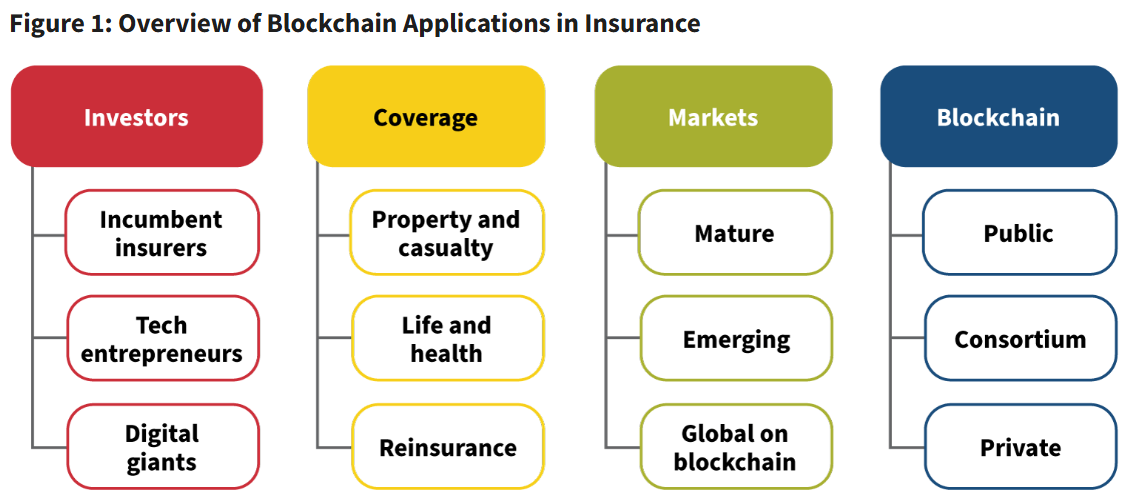
Where Innovation Meets Risk Management
At their core, both blockchain and insurance are about distributing risk through trust. The alignment is elegant:
Trust: Immutable records provide a single source of truth
Transparency: All authorized participants access the same data simultaneously
Immutability: Data can’t be changed without consensus, deterring fraud
These traits directly address longstanding industry issues—fragmented data, high administrative costs, and limited trust between stakeholders.
Transforming Core Insurance Operations
Smart Contracts: The Automation Revolution
Smart contracts might be blockchain’s most radical contribution to insurance. These self-executing agreements can automatically verify claims by linking to real-world data sources—like patient health records or satellite-based weather indices.
Parametric insurance is an ideal use case: payouts triggered by pre-defined events (e.g., rainfall below a certain level), with no need for subjective assessments. With on-chain oracles feeding this data, the model is low-overhead, transparent, and fast.
Beyond simple automation, companies like Circuit are taking this a step further with asset extraction technology that can automatically move digital assets from danger to safety without taking custody. This prevention-first approach transforms the insurance model from compensation after loss to active protection, making it easier for insurers to underwrite policies like crime coverage.
Fraud Detection: Immutable Advantages
Insurance fraud costs the industry billions. Blockchain can curb this by linking siloed databases and creating tamper-proof audit trails. Insurers can spot red flags early and prevent fraudulent payouts—before they happen.
Interoperable Data: Breaking Down Silos
Blockchain enables interoperable, privacy-preserving data repositories. In health or life insurance, electronic health records tied to wearable data could allow real-time risk assessments and dynamic pricing—encouraging healthy behaviors via premium incentives.
Streamlined Underwriting: From Weeks to Minutes
With permissioned blockchain access to verified customer data, insurers can dramatically accelerate underwriting. According to Deloitte, real-time underwriting can boost conversion rates from 70% to nearly 90%. That’s not a marginal improvement—it’s a business model shift.
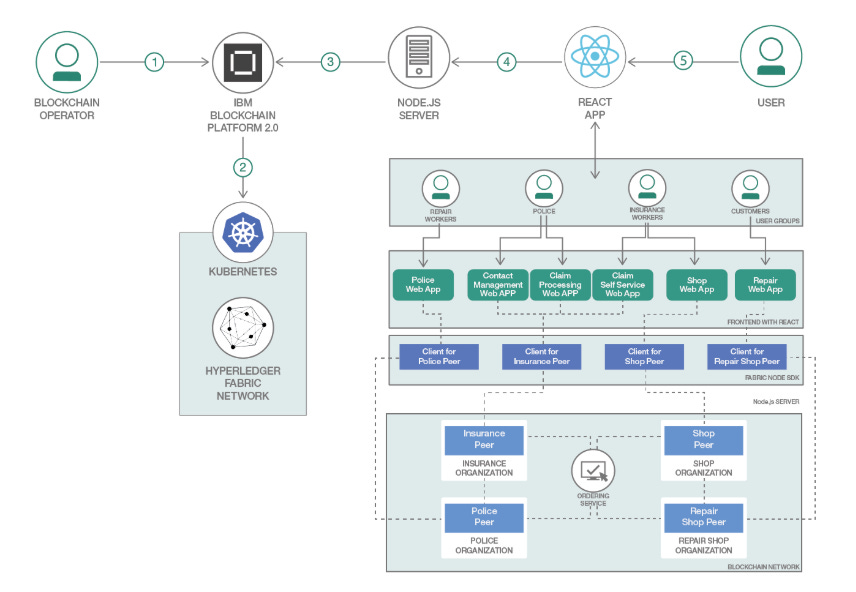
Insuring Crypto Itself: The New Frontier
Ironically, one of blockchain’s clearest insurance use cases is... crypto itself.
Protocols like Cork are also helping reshape how risk is priced and managed in crypto, particularly around pegged assets. Cork enables users to hedge or speculate on the likelihood of a stablecoin or staking token depegging through tokenized instruments akin to credit default swaps. These Depeg Swaps allow participants to earn yield by underwriting depeg risk or to protect themselves from it—completely on-chain and fully collateralized. With support for assets like USDT, USDe, and staked ETH variants, and integrations with protocols like Lido and Ethena, Cork is building the foundation for a decentralized risk marketplace—where users don’t just protect against volatility, they participate in pricing it.
The digital asset market has lost billions to hacks, exploits, and lost keys. Insurance is the safety net that can make crypto palatable to institutions—and the retail crowd.
Emerging product categories include:
Custodial Insurance – Cold wallet risk coverage
Smart Contract Coverage – Protection for dApps and DeFi platforms
Hot Wallet/Crime Insurance – Coverage for exchanges and DAOs
Slashing Protection – For validators and stakers
Projects like Nexus Mutual and Etherisc are building DeFi-native insurance protocols. They remain small but meaningful steps toward risk markets native to the crypto ecosystem.
Another example of this shift is DEIN, a decentralized, omnichain insurance and prediction marketplace that lets users design and trade coverage for virtually any risk—across digital assets, smart contracts, exchanges, and even real-world events. Governed entirely by its DAO, DEIN removes intermediaries and enables a permissionless, peer-to-peer underwriting system. What makes it notable is its modular, scalable infrastructure paired with a game-theoretic claims process, where voters are rewarded or penalized based on accuracy. With integrated AI for risk assessment and support for 150+ blockchains, DEIN is pushing the insurance model toward a more participatory, transparent, and user-controlled future.
Case Studies: Lessons in What (Not) to Build
Blockchain’s insurance journey offers rich lessons. Two stories stand out.
B3i: Ambition Meets Reality
The Blockchain Insurance Industry Initiative (B3i), backed by heavyweights like Allianz and Swiss Re, aimed to revolutionize reinsurance with shared ledgers. It promised streamlined claims, accounting, and data sharing. But in 2022, B3i folded, unable to secure $20 million in funding. Why? It chased too many goals at once, was bogged down by complex governance, and failed to to prove value.
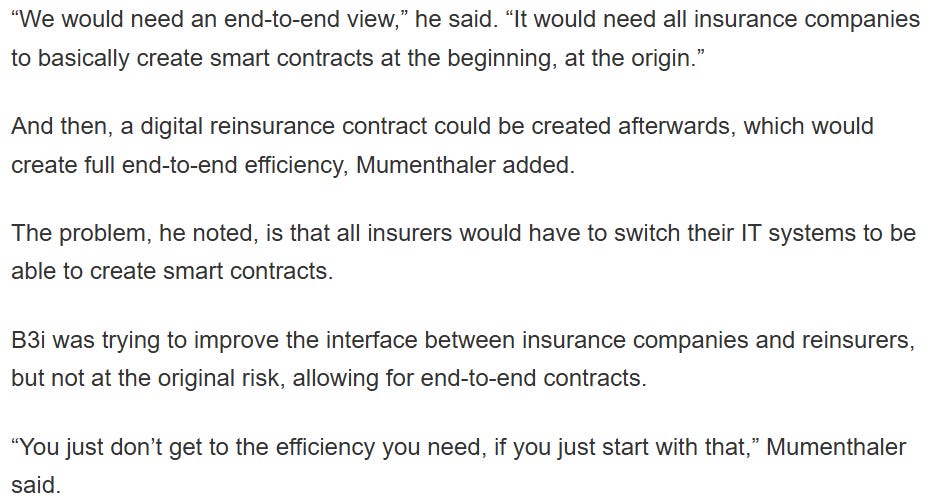
The takeaway: the integration of blockchain technology with traditional finance should be explored in increments, operators shouldn’t chase tech for tech’s sake. Clear focus and pull-driven demand are non-negotiable.
Nexus Mutual: DeFi’s Quiet Win
Nexus Mutual, a decentralized insurance DAO, shows what’s possible when focus meets execution. It has issued $5.5 billion in policies for crypto risks—smart contract failures, exchange hacks—and processed over $18M in claims while staying solvent. Its community-driven model resonates in DeFi, but growth has plateaued. Scaling beyond crypto, diversifying risk pools, and weathering bear markets remain hurdles.
Active Nexus Mutual Cover Value (in millions, USD)
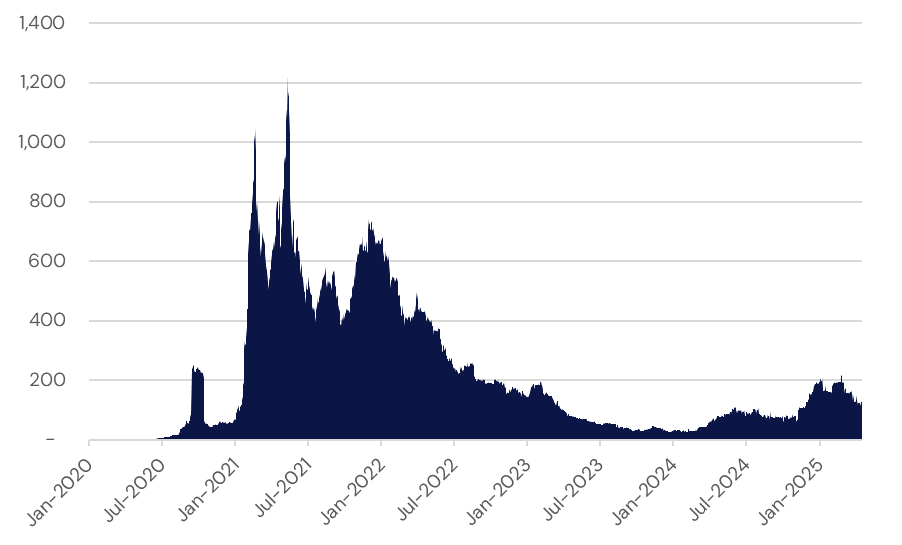
Nexus proves blockchain can work in insurance—but product-market fit isn’t enough. Distribution and resilience are just as critical.
Barriers to Scale: Why Blockchain Insurance Hasn’t Broken Through
Despite its clear potential, blockchain’s integration into insurance has been anything but smooth. One of the biggest hurdles remains regulatory uncertainty. The rules around digital assets—and by extension, blockchain-enabled insurance—are still in flux. This ambiguity complicates everything from product design to distribution. As a result, companies are left building in gray zones, which stifles ambition and slows execution.
Technical and operational challenges add another layer of friction. Many blockchain networks still face limitations in processing speed, while integrating new systems with legacy IT infrastructure remains an expensive and complex task. Privacy concerns also linger. Blockchain’s transparency is a strength in many contexts, but in industries like health and life insurance—where data protection is paramount—it can quickly become a liability. Advancements in technology like zero-knowledge proofs, and fully-homomorphic encryption are encouraging, but without clear pathways to balancing transparency and compliance, meaningful adoption will remain slow.
The insurance industry’s conservatism is another major factor. With so many stakeholders—insurers, reinsurers, brokers, regulators, and customers—achieving consensus is inherently difficult. Add to that the reality that blockchain’s short-term ROI is hard to quantify, and you end up with a sector reluctant to take on big transformation bets. Moreover, competitive dynamics discourage the kind of data-sharing blockchain thrives on. For insurers used to guarding proprietary information, the notion of feeding a shared ledger—even in a permissioned context—can feel like a bridge too far.
Together, these barriers help explain why most blockchain insurance efforts remain stuck in pilot mode. The technology is viable. The demand is there. But the path to scale is slow and full of friction—a theme likely to persist for the near future.
Strategic Playbook: How to Get It Right
Blockchain’s potential in insurance is undeniable, but success demands strategy. Here’s how to move the needle:
Target High-Impact Use Cases: Focus on sweet spots like parametric insurance (e.g., weather-triggered payouts), microinsurance for underserved markets, or reinsurance data flows. These deliver clear wins without overhauling entire systems.
Collaborate Smartly: B3i’s failure doesn’t discredit partnerships—it highlights the need for lean governance. Streamlined consortia, industry standards, and regulatory dialogue can align stakeholders. Firms like Aquanow, specialists in digital asset integration, help bridge traditional financial infrastructure with crypto’s agility.
Invest with Discipline: Balance pilots with capability-building. Diversify bets—some incremental, some disruptive—and reassess regularly. Internal expertise, via training or partnerships, is as vital as tech.
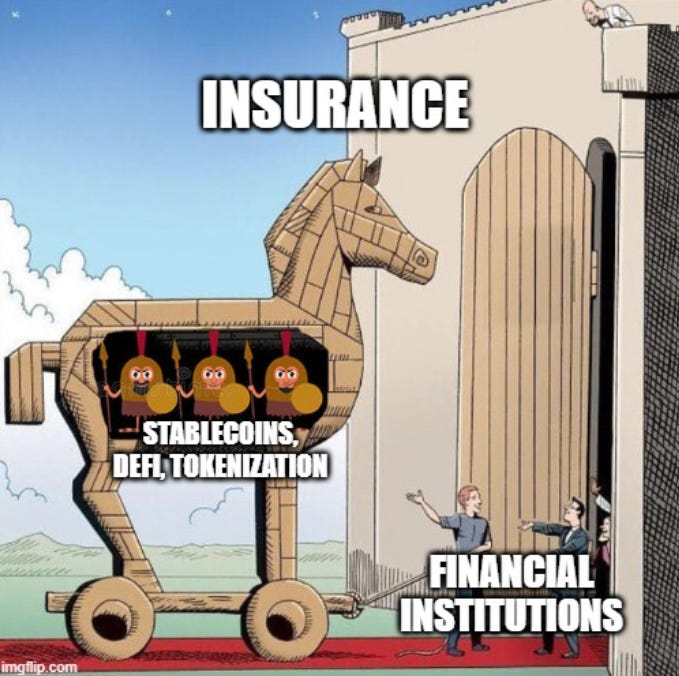
Closing Thoughts: Insurance as a Trojan Horse
Here’s the big unlock: insurance could be crypto’s backdoor to the mainstream. Not by minting millionaires, but by making risk palatable. When stablecoin treasuries carry A-rated coverage, staking losses are insured, and cold wallets are secure, institutions won’t just test the waters—they’ll dive in. Blockchain-powered insurance could also narrow the global protection gap, bringing microinsurance to billions in underserved regions, formalizing trust where informal systems once ruled.
The road isn’t smooth. B3i’s collapse shows the peril of overreach, and even successes like Nexus Mutual face scaling pains. Yet the fundamentals—trust, transparency, efficiency—are too compelling to ignore. Insurance may lack crypto’s sizzle, but its role in anchoring digital finance is foundational. As blockchain matures and regulations clarify, this convergence could redefine how we manage risk in a digital age.
Q: Why does insurance matter for the growth of crypto?
A: Because it helps de-risk the system. Institutions aren’t waiting for perfect technology—they’re waiting for reliable guardrails. Insurance brings predictability to an unpredictable ecosystem. When digital assets, staking operations, and smart contracts are insured, it lowers the perceived risk and opens the door for broader adoption.
Q: What makes insurance and blockchain such a good match?
A: They’re both systems built on trust, record-keeping, and distributed risk. Blockchain replaces paper trails with tamper-proof ledgers and enables smart contracts that can automate payouts. Insurance, meanwhile, thrives on data and coordination. The combination streamlines claims, reduces fraud, and makes real-time underwriting possible.
Q: Why hasn’t blockchain insurance scaled yet?
A: Several reasons: regulatory uncertainty, technical complexity, and institutional inertia. The tech works, but aligning legacy systems, navigating unclear compliance requirements, and convincing conservative insurers to collaborate on shared infrastructure is no small feat. Add privacy concerns and unclear ROI, and progress has been understandably slow.
Q: Is there any part of insurance where blockchain is already making an impact?
A: Yes—primarily in parametric insurance (where claims are paid based on objective triggers like weather data) and in DeFi-native coverage like what Nexus Mutual and Etherisc offer. These are areas where automation, transparency, and speed matter more than traditional underwriting nuance.
Q: What’s the big opportunity going forward?
A: Blockchain won’t replace insurance—it’ll modernize it. The real opportunity lies in delivering more inclusive, more efficient, and more secure insurance products—whether that’s microinsurance for underserved populations or institutional coverage for digital assets. Success will require collaboration across the ecosystem. Working with domain experts like Aquanow, who specialize in integrating digital assets into traditional financial systems, can accelerate implementation, reduce friction, and bridge the knowledge gap between incumbents and crypto-native infrastructure.
This is a game changer for the finance scene. It’s cool to see how insurance is stepping up to the plate with blockchain tech. Bridging that trust gap could really reshape how we think about risk and coverage in the future. Exciting times ahead!